

ICICI Bank Logo ICICI Bank Logo

National Pension System (NPS) FAQs

Product Overview

EXPAND ALL

How is NPS structured through POP, CRA, NPS Trust and PFMs?

NPS works through a robust and secure ecosystem:

  • PFRDA – Governs and regulates the scheme

  • NPS Trust – Protects subscriber assets

  • CRA (NSDL/KFin/CAMS) – Maintains your NPS records, PRAN and transactions

  • POP (Point of Presence) – Banks like ICICI Bank that help you open and manage your account

  • Pension Fund Managers – Invest your contributions across asset classes

This layered structure ensures efficient servicing, transparent reporting and strong governance of your retirement money.

What is a PRAN and why is it important?

Your PRAN (Permanent Retirement Account Number) is a unique 12-digit number issued once your NPS account is activated. It acts as your lifelong retirement account identifier. Whether you change jobs, cities or even sectors, your PRAN remains the same, ensuring complete portability and uninterrupted servicing.

What is the National Pension System (NPS)?

The National Pension System (NPS) is a long-term retirement savings product backed by the Government of India and regulated by PFRDA. It enables individuals to save systematically throughout their working life so they can build a secure and reliable retirement corpus. Contributions are invested in professionally managed, market-linked portfolios, helping your wealth grow steadily over time. At retirement, NPS offers a balanced combination of lumpsum withdrawal and regular pension, giving you financial comfort in your golden years.

How does NPS help in retirement planning?

NPS supports retirement planning through disciplined, long-term investing. As you contribute regularly, your funds accumulate and benefit from market appreciation and compounding. On maturity, NPS provides both lumpsum liquidity and a monthly pension through annuity purchase. This structure ensures that you not only build a robust corpus but also receive a steady income during post-retirement life — helping you manage expenses comfortably.

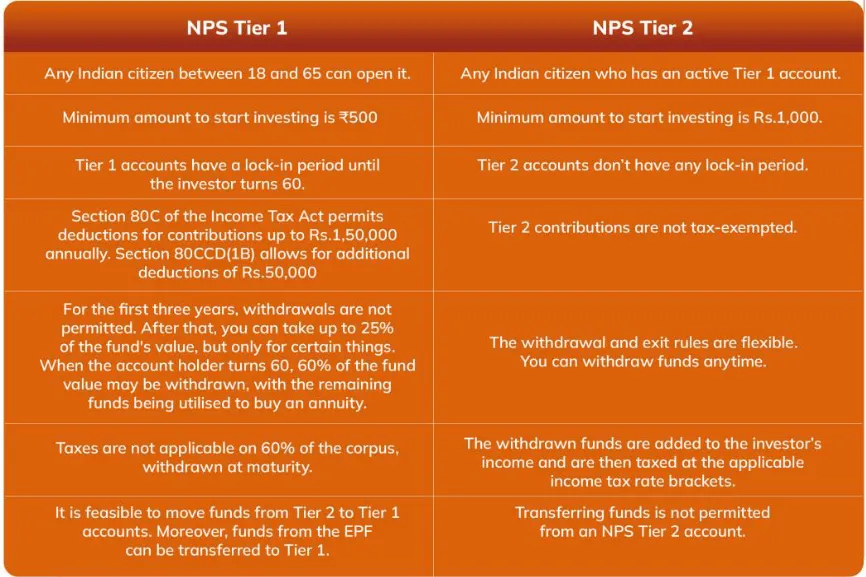
What is the difference between Tier I and Tier II Accounts?

Under the NPS Account, there are two types of Accounts - NPS Tier I & Tier II account. Tier I Account is mandatory and the subscriber has the choice to opt NPS Tier II Account.
NPS Tier 1

NPS Tier 2

Any Indian citizen between 18 and 65 can open it

Any Indian citizen who has an active Tier 1 account

Minimum amount to start investing is Rs 500

Minimum amount to start investing is Rs 1000

Tier 1 accounts have a lock-in period until the investor turns 60

Tier 2 accounts don’t have any lock-in period

Section 80C of the Income Tax Act permits deductions for contributions up to ₹1,50,000 annually. Section 80CCD(1B) allows for additional deductions of ₹50,000.

Tier 2 contributions are not tax-exempted.


For the first three years, withdrawals are not permitted. After that, you can take up to 25% of the fund’s value, but only for certain specified purposes.


The withdrawal and exit rules are flexible. You can withdraw funds anytime.


Taxes are not applicable on 60% of the corpus withdrawn at maturity.

The withdrawn funds are added to the investor’s income and are then taxed at the applicable income-tax rate brackets.


It is feasible to move funds from Tier 2 to Tier 1 accounts. Moreover, funds from the EPF can be transferred to Tier 1.

Transferring funds is not permitted from an NPS Tier 2 account.


Who regulates NPS?

NPS is regulated by the Pension Fund Regulatory and Development Authority (PFRDA), ensuring complete transparency, investor safety and strict adherence to national pension policies. PFRDA sets investment guidelines, monitors pension fund managers and oversees the NPS Trust so that your retirement savings remain well-protected.

Which account is compulsory under NPS?

Tier I is mandatory as it forms the core retirement account. Tier II can be activated any time after Tier I is opened.

Who invests my contributions in NPS?

Investments are handled by professionally managed Pension Fund Managers appointed and monitored by PFRDA. These experts invest across equity, corporate debt, government securities and alternative assets based on your chosen allocation—ensuring disciplined portfolio management.

What investment choices does NPS offer?

NPS offers four asset classes:

  • Equity (E) – For long-term growth

  • Corporate Debt (C) – For steady returns

  • Government Securities (G) – For safety and stability

You may choose your allocation or let the system automatically allocate based on age and risk profile.

What are the different Fund Management Schemes available to the subscriber?

NPS offers two approaches to invest the subscriber’s money:


a) Active choice – Here the individual would decide on the asset classes in which the contributed funds are to be invested and their percentages (Asset Class E (maximum of 75%), Asset Class C and Asset Class G

b) Auto choice - This is the default option under NPS wherein the management of investment of funds is done automatically based on the age profile of the subscriber.

What is the lock-in period for NPS?

Tier I has a lock-in until age 60 or a min of 15 years post opening the account or the date of retirement of the customer if the account is a corporate PRAN (whichever is lesser), ensuring your savings remain dedicated to retirement goals. Tier II has no lock-in and can be withdrawn anytime.

What is the minimum age to join NPS?

Any Indian citizen aged 18 years and above can join NPS after completing KYC. NPS Vatsalya accounts can be opened for minors below the age of 18 years.

What is the maximum age to open NPS?

Individuals can join NPS up to 85 years of age, making it suitable even for late-career retirement planning.

Can I continue NPS after I turn 60?

Yes. You may continue contributing up to age 85 if you choose. This extension can help boost your corpus and take advantage of market-linked growth for a longer duration.

How portable is NPS across employers and locations?

NPS is completely portable across sectors, employers, states and cities. Regardless of job changes or relocations, your PRAN remains unchanged and servicing continues seamlessly.

Is NPS a guaranteed return scheme?

NPS is a market-linked retirement product and does not offer guaranteed returns. However, strong regulatory oversight, diversified investments and professional fund management help build stable long-term wealth.

How does NPS compare with EPF and PPF?

  • EPF/PPF: Fixed-income, government-backed savings

  • NPS: Market-linked with higher long-term return potential
    NPS is ideal for individuals looking to complement their fixed-income retirement savings with market-driven growth.

Documents Required

EXPAND ALL

Is Aadhaar mandatory for opening NPS?

Aadhaar is not mandatory but highly recommended. It enables instant OTP-based e-KYC, faster PRAN generation and a completely paperless onboarding experience.

Is PAN compulsory for NPS registration?

Yes. PAN is mandatory to ensure accurate verification, tax compliance, and smooth account servicing across all platforms including ICICI Bank POP and CRA portals.

What documents are required for NRI subscribers?

NRIs must submit a valid passport, overseas address proof, PAN and NRE/NRO bank account details. FEMA-compliant declarations may also be required.

What constitutes valid address proof for NPS?

Any government-issued address proof such as Aadhaar, Passport, Driving Licence or Voter ID is acceptable. Bank statements and utility bills are also permitted, subject to regulatory norms.

Is bank proof required for NPS?

Yes. A cancelled cheque or bank statement ensures accurate mapping of your bank account for contributions, withdrawals and annuity payouts.

Is additional documentation needed to activate Tier II?

No new documents are required if Tier I KYC is already completed. Tier II can be activated through a simple request.

What is e-KYC for NPS?

e-KYC verifies your identity using Aadhaar OTP authentication. It eliminates physical paperwork and enables instant online account creation.

How can I update or re-submit KYC for NPS?

You may update your details through ICICI Bank (POP), the CRA portal or Aadhaar-based online authentication. Updated documents will be reviewed and approved by the CRA.

What happens if my NPS KYC is on hold or rejected?

Your PRAN activation may remain pending. You must re-submit the correct documents or update any mismatched details to complete verification successfully.

What documents are required for NPS KYC?

You need basic KYC documents such as PAN, Aadhaar (for e-KYC), an address proof, bank account details and a photograph. These documents help establish identity and ensure secure processing of your retirement account.

Eligibility & Application

EXPAND ALL

Can government employees open NPS through ICICI Bank?

Government employees typically enrol through their department or nodal office. However, they may access certain servicing features via ICICI Bank depending on their employer’s structure.

Can NPS be opened entirely online through ICICI Bank?

Yes. ICICI Bank supports a fully digital Aadhaar-based onboarding process where you can open NPS, receive your PRAN and start contributing instantly — all without visiting a branch.

Can NRIs enrol in NPS?

Yes. NRIs can join NPS using their NRE/NRO bank accounts. Contributions must comply with FEMA norms and must be made through inward remittances.

Can minors open NPS?

Yes. The Government of India has introduced NPS Vatsalya for minors, which enables parents to start securing their child’s financial future early. The parent acts as the guardian of the account until the minor attains 18 years of age. The scheme is regulated by the Pension Fund Regulatory and Development Authority (PFRDA) and helps build a strong financial foundation for the child from an early stage.

From Branch

  • Visit a Point of Presence (PoP) Service Provider

  • Collect the NPS Vatsalya application form and submit it along with the necessary KYC documents and initial contribution.

  • Bank officials will assist in completing the application.

  • The account will be opened after verification, and PRAN will be issue

Can I open more than one NPS account?

Yes. Any individual is allowed to open one PRAN with all the three CRA i.e. Protean, KFintech and CAMS. This can either be a Common Scheme PRAN or a MSF PRAN.

Can I open NPS if I already contribute to EPF?

Yes. Many salaried individuals use NPS in addition to EPF to enhance their retirement corpus and maximize tax benefits.

Can I invest in PPF along with NPS?

Yes. NPS and PPF complement each other well. While PPF ensures guaranteed, fixed returns, NPS provides market-driven growth, giving your retirement plan a balanced structure.

Can homemakers open NPS?

Yes. Homemakers may enrol provided they have a valid bank account and complete KYC. Contributions must be made from their own account.

Can individuals aged 60–70 join NPS?

Yes. Individuals can join NPS up to age 85 can enrol in the product, enabling late-stage retirement planning.

How can I move my existing NPS account to ICICI Bank POP?

You can submit a POP-SP Change Request to ICICI Bank. Once processed, servicing rights are transferred to ICICI Bank while your PRAN and accumulated corpus remain unchanged.

How do I reactivate my frozen NPS account?

You may reactivate your PRAN by paying the minimum required contribution and any applicable CRA/POP charges. Once credited, your account becomes active immediately.

Can Tier I be converted into Tier II?

Tier I cannot be converted. However, once Tier I is active, you can easily open a Tier II account to enjoy flexible withdrawals. There is one-time shift option available for customers to send funds from their Tier II account to their Tier I account.

Can I open or manage NPS through iMobile App?

Yes. iMobile App offers seamless onboarding, contribution tracking, portfolio view and instant payments — making NPS servicing convenient and paperless.

Who can open an NPS account through ICICI Bank?

Any Indian citizen—resident or NRI or Overseas Citizen of India (OCI) —aged 0-85 years can open NPS through ICICI Bank after completing the mandatory KYC steps. ICICI Bank offers both online and branch-based enrolment options.

Fees, Interest & Charges

EXPAND ALL

What are the fund management charges under NPS?

Fund management charges under NPS are extremely low — typically under 0.10% annually. This makes NPS one of the most cost-efficient retirement solutions, allowing more of your money to remain invested and grow.

Does ICICI Bank charge a POP fee?

As a Point of Presence, all banks including ICICI Bank has been mandated by the regulator to charge 0.2% annual rate of interest on the complete AUM of the customer. These charges are deducted quarterly by the CRA and ICICI Bank does not deduct these at the time of account opening, contribution processing or any non-financial servicing.

What are contribution or servicing charges?

ICICI Bank does not charge any contribution or servicing fees up-front from the customer. However, as per mandatory regulatory guidelines, the CRA deducts 0.2% annual rate of interest on the complete AUM of the customer pro-rata basis every quarter.

Are partial withdrawals subject to any charges?

Partial withdrawals typically do not attract POP charges. CRA may levy nominal administrative fees depending on the request type.

Are exit charges applicable under NPS?

Yes. Certain exit charges may apply when exiting before 60, at maturity or for specific withdrawal types. These charges are nominal and governed by PFRDA.

Are annuity purchase charges applicable?

Yes. Annuity Service Providers may levy charges when issuing annuity policies. These are disclosed at the time of annuity selection and vary across providers and plans.

What is the annual account maintenance fee?

CRA levies an annual fee to maintain your NPS account, ensure secure recordkeeping and support your service transactions. This fee is deducted automatically.

Are charges for Tier II different?

Yes. Transaction charges for Tier II may differ slightly based on contributions, withdrawals and CRA policies, but remain minimal and transparent.

Is GST applicable to NPS-related charges?

Yes. GST is applied as per government regulations on POP and CRA charges. Exact tax amounts are displayed during transaction processing.

What charges are applicable under the CRA for NPS?

CRA levies nominal account opening charges, annual maintenance fees and transaction processing charges. These deductions are transparent and among the lowest globally for retirement products.

Credit Limit & Usage

EXPAND ALL

What is the minimum contribution required annually?

Subscribers must contribute at least ?1,000 per financial year to keep the Tier I account active. This ensures your retirement savings continue uninterrupted.

What is the minimum amount for Tier II contributions?

Tier II contributions start at ?250 per transaction, offering great flexibility for short-term savings and withdrawals.

Is there a maximum limit for contributions?

There is no upper limit for contributions in either Tier I or Tier II. You may invest as per your retirement planning goals and surplus funds.

Can I contribute multiple times in a month?

Yes. NPS allows unlimited contributions throughout the year. You may contribute monthly, quarterly or at any frequency convenient to you.

Can I temporarily stop contributions?

Yes. You may pause contributions; however, if you fail to invest ?1,000 in a financial year, your account may be marked as inactive. In order to reactivate the Account, the subscriber will have to pay the minimum contribution amount.

What happens if I do not make the minimum annual contribution?

Your account may become “frozen.” This can be reactivated by making the required contribution and paying nominal CRA/POP fees.

Will my PRAN be frozen if I miss contributions?

Yes. Missing the minimum annual contribution may lead to temporary freezing. Reactivation is easy and takes effect once the required payment is made.

Can I make contributions in cash?

Yes. A customer can deposit a maximum of Rs 50,000 via branches, However it is advised that contributions must be made digitally or through bank channels such as Net Banking, UPI or debit card to ensure transparency and traceability.

Can my employer contribute to my NPS account?

Yes. Employers can contribute directly to your NPS Tier I account. Such contributions often come with attractive tax benefits under Section 80CCD(2), making it highly advantageous for salaried individuals.

What is the minimum first contribution for NPS?

There is no minimum first contribution criteria in NPS.

Rewards & Offers

EXPAND ALL

What additional tax benefits are available under Section 80CCD(1B)?

NPS offers an exclusive additional tax deduction of ?50,000 under Section 80CCD(1B), which is over and above the ?1.5 lakh limit under Section 80C. This makes NPS one of the most tax-efficient retirement products in India.

What tax benefits are available for employer contributions under Section 80CCD(2)?

Employer contributions to NPS (up to 'upto 14% of basic +DA for private sector employees, and 14% for central government employees) are exempt from tax in the hands of the employee. There is no upper monetary limit, making it a powerful tax-planning option for salaried individuals.

Are Tier II contributions eligible for tax benefits?

Tier II contributions generally do not offer tax benefits. However, for Central Government employees, Tier II contributions qualify for deductions under Section 80C, subject to a 3-year lock-in.

Are there any exclusive ICICI Bank offers for NPS?

From time to time, ICICI Bank may offer enhanced digital convenience, simplified e-KYC, advisory support and seamless contribution journeys via iMobile App and Net Banking. While NPS itself cannot offer rewards, ICICI Bank focuses on superior customer experience and ease of investing.

Can I receive tax statements for claiming deductions?

Yes. You can download contribution receipts and tax statements through:

  • ICICI Bank Net Banking (Login>Investment>National Pension System)

  • iMobile App (Login> Invest> NPS)

  • CRA portal (NSDL/KFin/CAMS)
    These can be used while filing income tax returns.

Can self-employed individuals get tax benefits under NPS?

Yes. Self-employed individuals can claim the standard 80CCD(1) deduction and the additional ?50,000 benefit under 80CCD(1B). They can also contribute higher amounts to optimise retirement savings.

Are NPS tax benefits available even if I contribute irregularly?

Yes. Tax benefits are available for all eligible contributions made during the financial year, irrespective of contribution frequency or timing.

Is NPS suitable for high-income earners looking for tax optimisation?

Absolutely. The additional ?50,000 deduction under Section 80CCD(1B) and employer contribution benefits under 80CCD(2) make NPS one of the best tax-saving avenues for high-income taxpayers.

Does NPS offer any loyalty or bonus benefits?

NPS does not provide loyalty bonuses. Instead, the value grows through market-linked returns and long-term compounding, ensuring that your retirement corpus increases sustainably.

What tax benefits are available under Section 80CCD(1)?

Under Section 80CCD(1), contributions made to NPS are eligible for tax deduction up to ₹1.5 lakh per financial year (within the overall limit of Section 80C/CCE). This benefit is available to both salaried and self-employed individuals. It helps reduce taxable income while enabling long-term retirement planning.

Add-On Features

EXPAND ALL

Can I add multiple nominees?

Yes. NPS allows multiple nominees, and you can specify the percentage share for each nominee. This helps distribute your retirement corpus as per your wishes.

Can I update or change nominee details?

Yes. You can update, modify or delete nominee details anytime through ICICI Bank (POP), iMobile App or the CRA portal. Updated details take effect after verification.

Can I switch my Pension Fund Manager (PFM)?

Yes. NPS allows you to switch your PFM up to once per financial year. This flexibility helps you align investments with fund performance and personal risk preferences.

How often can I change my investment choice or asset allocation?

You can change your investment choice (Active or Auto) or modify asset allocation up to four times in a financial year. This ensures flexibility while maintaining disciplined investing.

Can I switch from Auto Choice to Active Choice or vice versa?

Yes. You can switch between Auto and Active Choice anytime within the permitted limits. This ensures that your NPS strategy evolves with your needs and comfort level.

Can I change allocation across E, C and G classes?

Yes. Within the Active Choice framework, you can customise your allocation across equity, corporate bonds, government securities and alternative assets—allowing full control over your risk profile.

Can I reduce my equity exposure as I age?

Yes. You may manually reduce equity exposure under Active Choice or opt for Auto Choice lifecycle funds, where the system automatically reduces equity allocation as you approach retirement.

Can I change my POP after opening the account?

Yes. You can shift your servicing rights to ICICI Bank by submitting a POP-SP Change Request. Your PRAN and accumulated balance remain unaffected.

Can I activate both Tier I and Tier II through ICICI Bank?

Yes. ICICI Bank supports both Tier I and Tier II account activation, offering complete flexibility for long-term retirement planning and short-term liquidity.

Can I nominate beneficiaries under NPS?

Yes. You can nominate one or more individuals to receive your NPS corpus in the event of your demise. Nomination ensures smooth settlement and protects your family’s financial interests.

Benefits

EXPAND ALL

How does NPS help build long-term retirement wealth?

NPS leverages long-term investing, compounding and diversified asset allocation to gradually build a strong retirement corpus. Regular contributions, even in modest amounts, can grow significantly over time when invested consistently.

How does compounding work in NPS?

Compounding enables your returns to generate further returns. Since NPS is a long-term product, compounding plays a major role in building a larger corpus, especially when contributions are made regularly.

How do NPS returns compare with mutual funds?

NPS offers a well-balanced investment approach with exposure to equity, corporate bonds and government securities. While mutual funds provide greater flexibility, NPS offers lower charges and long-term retirement-focused portfolios, resulting in potentially stable and efficient returns.

How does NPS generate returns?

Returns are generated through investments in equity markets, corporate debt and government securities based on your chosen allocation. Professional Pension Fund Managers manage and rebalance portfolios in line with regulatory guidelines.

Are withdrawals from NPS tax-efficient?

Returns are generated through investments in equity markets, corporate debt and government securities based on your chosen allocation. Professional Pension Fund Managers manage and rebalance portfolios in line with regulatory guidelines.

How does NPS provide income after retirement?

A part of your maturity value (minimum 20%) is used to purchase an annuity from an approved service provider. This annuity provides monthly pension, ensuring that you enjoy regular income throughout retirement.

Is NPS suitable for salaried individuals?

Yes. Salaried individuals benefit significantly from employer contributions and enhanced tax savings. NPS complements existing retirement schemes such as EPF and offers additional financial stability.

How does NPS benefit self-employed individuals?

Self-employed individuals can claim both the standard deduction (under 80CCD(1)) and the additional ?50,000 deduction (under 80CCD(1B)). Low charges and long-term growth make NPS ideal for building retirement wealth independently.

What are the key advantages of NPS?

Yes. You can download contribution receipts and tax statements through:

  • ICICI Bank Net Banking (Login>Investment>National Pension System)

  • iMobile App (Login> Invest> NPS)

  • CRA portal (NSDL/KFin/CAMS)
    These can be used while filing income tax returns.

Billing & Payments

EXPAND ALL

Which payment modes are supported for contributions?

NPS supports payments through Net Banking, UPI, debit card and sometimes credit card (as permitted by CRA). Contribution receipts are generated instantly.

Will I receive a receipt for each contribution?

Yes. You will receive an acknowledgement immediately through SMS/Email. Contribution details are also available on NPS dashboard of iMobile app and Net Banking or on CRA portal. You can also download the statement.

How can I download my contribution statement?

Statements can be downloaded from:

  • iMobile App (Login>Invest>NPS>NPS Dashboard> Download Statement)

  • Net Banking (Login>Investment>National Pension System>NPS Dashboard> Download Statement)

  • CRA portal (NSDL/KFin/CAMS)
    These statements detail contributions, NAVs, returns and holdings.

How long does it take for units to be allotted?

Units are allotted on the basis of the applicable NAV once the contribution is successfully processed and reconciled by CRA/PFM. This typically takes one to two business days.

What NAV is applied for NPS contributions?

The NAV is applied based on the cut-off time and the day the contribution is received by the Pension Fund Manager. Contributions made after the cut-off may be allotted the next business day’s NAV.

How can I check whether my contribution has been processed?

You can view the status instantly on:

  • iMobile App (Login>Invest>NPS>NPS Dashboard> last 5 transaction)

  • Net Banking (Login>Investment>National Pension System>NPS Dashboard> last 5 transaction)

  • CRA portal (NSDL/KFin/CAMS)
    A confirmation message is also sent via SMS and email.

How can I make NPS contributions through ICICI Bank?

You can contribute seamlessly through:

  • iMobile App (Login>Invest> NPS> Click on Make contribution)

  • Net Banking (Login>Investment> National Pension System> Click on Make contribution)

  • ICICI Bank branches
    Payments can be made using Net Banking, UPI or debit card, ensuring a smooth contribution experience.

Premature Withdrawals & Exit Rules

EXPAND ALL

What purposes qualify for partial withdrawal?

Permitted purposes include:

  • Higher education

  • Marriage of children

  • Purchase or construction of a house

  • Critical illness treatment

  • Skill development courses
    These withdrawals are tax-exempt.

How many times can I make partial withdrawals?

Up to four partial withdrawals are allowed during your entire NPS tenure, subject to meeting eligibility criteria.

Is partial withdrawal taxable?

No. Eligible partial withdrawals of up to 25% of subscriber’s own contributions are completely tax-free.

What happens if I exit NPS before 60/15 years of account opening/Date of Retirement?

If you exit before 60/15 years of account opening/Date of Retirement:

  • 80% of your corpus must be used to purchase an annuity

  • 20% can be withdrawn as lump sum
    This ensures continuity of pension benefits.

Can I withdraw my entire corpus before 60/15 years of account opening/Date of Retirement?

Complete withdrawal is not permitted unless the total accumulated corpus is ?5 lakh or less, in which case the full amount may be withdrawn without annuity purchase and there is no lock-in period for the same.

What are the maturity rules at age 60/15 years of account opening/Date of Retirement?

You may:

  • Withdraw up to 80% of the accumulated corpus tax-free

  • Use at least 20% to purchase an annuity for monthly pension

You may also defer either withdrawal or annuity purchase if desired.

Can I defer my lumpsum withdrawal or annuity purchase?

Yes. You may defer:

  • Lumpsum withdrawal up to age 85

  • Annuity purchase for a specified period
    This flexibility allows better market timing and financial planning.

Is annuity income taxable?

Yes. Monthly pension received from the annuity is taxed as per your applicable income tax slab.

What are the rules for partial withdrawal from NPS?

Partial withdrawal is allowed after 3 years of NPS membership and can be done a total of 4 times in the customers NPS life cycle. Post the first withdrawal the next 3 withdrawals have to be spaced after 4 years each. These can be done for specific purposes such as education, marriage, home purchase or medical treatment. You may withdraw up to 25% of your own contributions.

Sip-Equivalent Features & Loans

EXPAND ALL

Can I set up auto-debit for NPS contributions?

Yes. ICICI Bank allows you to set bank mandates or standing instructions through Net Banking or iMobile App. Once activated, contributions are debited automatically, ensuring consistent investing without manual intervention.

Can I change my auto-debit date or amount?

Yes. You can modify the contribution amount or frequency anytime. Changes can be made through ICICI Bank channels or directly through the CRA portal, as per guidelines.

Can I borrow against my NPS balance?

Yes. A customer can secure a loan of up to 25% of self-contribution of their NPS funds post a lock-in period of 3 years of account opening.

What happens to standing instructions if I change my bank account?

If your bank account changes, the existing mandate becomes inactive. You must register a new auto-debit mandate through ICICI Bank or CRA to ensure uninterrupted contributions.

Can employers automate monthly contributions?

Yes. Employers can automate contributions for employees through payroll systems. These contributions often provide enhanced tax benefits under Section 80CCD(2).

Can I pause scheduled contributions temporarily?

Yes. You may pause contributions based on your financial situation. However, ensure that you contribute ?1,000 annually to keep your account active.

Does NPS offer features similar to Systematic Withdrawal Plans (SWPs)?

Yes. NPS offers an option of Systematic Lump Sum Withdrawal and Systematic Unit Redemption at the time of exit from the product.

Can NPS contributions be scheduled like SIPs?

Yes. While NPS does not function exactly like a mutual fund SIP, you can set a regular contribution pattern—monthly, quarterly or at any chosen frequency—through standing instructions or reminders. This helps build your retirement corpus systematically while maintaining complete control over the contribution amount.

Reload & Refunds

EXPAND ALL

What should I do if the payment is debited but not reflected in my NPS account?

In rare cases of payment delays, the amount may be under processing at CRA/PFM. If not updated within the expected timeline, the amount is automatically reversed to your bank account. You can also raise a query through ICICI Bank or CRA for tracking.

How long does it take to receive a refund for failed transactions?

Refunds for failed or incomplete transactions are typically processed within 3 to 7 working days depending on banking and CRA reconciliation timelines.

Can I change my payment mode later (e.g., Net Banking to UPI)?

Yes. You may choose a different payment mode anytime while contributing through ICICI Bank or CRA platforms. This ensures convenient investing across digital channels.

How do I track contributions that have failed or been reversed?

Failed or reversed transactions are visible in:

  • iMobile App (Login>Invest>NPS>NPS Dashboard>Last 5 transaction)

  • Net Banking (Login>Investment>National Pension System>NPS Dashboard>Last 5 transaction)

  • CRA transaction logs
    You will also receive SMS/Email notifications once the reversal is completed.

Can I contribute to NPS multiple times in a month?

Yes. NPS allows unlimited contributions, giving you complete flexibility to invest surplus funds whenever convenient. Each contribution is invested based on the applicable NAV.

Account Closure & Transfers

EXPAND ALL

What is the annuity purchase requirement at maturity?

A minimum of 20% of the corpus must be used to buy an annuity from a PFRDA-authorised Annuity Service Provider (ASP). The annuity provides regular monthly pension after retirement.

What happens to my NPS account in case of death?

In the event of the subscriber’s death, the entire accumulated corpus is paid to the nominee or legal heir. Annuity purchase is optional for the nominee unless specified otherwise.

How can nominees claim the NPS amount?

Nominees must submit:

  • Death certificate

  • ID and address proof

  • PRAN details

  • Claim form

Once verified, the corpus is settled directly into the nominee’s bank account.

Can I transfer my NPS servicing rights to ICICI Bank?

Yes. You may submit a POP-SP Change Request to shift your NPS servicing to ICICI Bank. All future contributions and customer support will be managed by ICICI Bank seamlessly.

Can I shift from an employer-managed NPS to ICICI Bank POP?

Yes. If you move from a corporate or government NPS environment to the private sector, you can shift servicing rights to ICICI Bank while retaining your PRAN and balance.

Can I continue NPS after resigning from my job?

Yes. NPS is completely independent of your employer. You may continue contributing voluntarily through ICICI Bank or self-contribute online at any time.

Can Tier II be closed anytime?

Yes. Tier II is fully flexible and can be closed anytime with complete withdrawal of your holdings. There are no exit restrictions.

How do I exit NPS at maturity?

At maturity, you may:

  • Withdraw up to 80% of the corpus lump-sum

  • Use at least 20% to purchase an annuity for monthly pension

ICICI Bank and CRA guide you through the exit process, annuity selection and documentation.

Security & Safety

EXPAND ALL

What investor protections does PFRDA provide?

PFRDA ensures:

  • Strict investment norms

  • Transparent reporting

  • Regulated fund manager performance

  • Safe custodianship of assets

  • Grievance redressal frameworks

This offers strong protection throughout your investment journey.

Are NPS funds guaranteed?

NPS does not guarantee returns since it is a market-linked product. However, investments are spread across diversified assets and managed professionally under PFRDA regulations to minimise risk and maximise long-term growth.

How safe are the Pension Fund Managers and custodians?

PFMs and custodians operate under stringent SEBI and PFRDA guidelines. They undergo periodic audits, performance evaluation and compliance checks to ensure transparency and stability of investments.

What security measures protect my online NPS account?

NPS platforms use:

  • Multi-factor authentication

  • Secure OTP validations

  • Encrypted communication

  • Secure CRA login credentials

This ensures your PRAN and investment data are safe at all times.

How do I report suspicious activity in my NPS account?

Immediately contact ICICI Bank or raise a grievance through the CRA portal. Quick reporting helps secure your account and initiate timely investigations.

How secure is NPS?

NPS incorporates multiple layers of security including regulated fund management, independent trusteeship by the NPS Trust, secure CRA recordkeeping, and PFRDA oversight. Your data and investments are protected through robust encryption and strong digital protocols across platforms.

Account Management

EXPAND ALL

How do I download my NPS transaction statements?

You can view your NPS holdings through:

  • iMobile App (Login>Invest>NPS>NPS Dashboard)

  • Net Banking (Login>Investment>National Pension System>NPS Dashboard)

  • CRA portal (NSDL/KFin/CAMS)
    These platforms display your contributions, units, NAV and total corpus value.

How do I update my mobile number, email or address in NPS?

Updates can be made through ICCI Bank Branches with required supporting documents or Aadhaar authentication or online through CRA Portal

How do I check the performance of my NPS schemes?

You can track scheme-wise NAVs, performance charts and asset allocation through the CRA portal or ICICI Bank’s NPS dashboard, which provides transparent and updated information.

How do I reset my I-PIN/TPIN for NPS?

You can verify PRAN status through iMobile App, the CRA portal or by contacting ICICI Bank POP. The portal displays whether the account is active, frozen or under verification.

How can I check my NPS balance?

You can view your NPS holdings through:

  • iMobile App (Login>Invest>NPS>NPS Dashboard)

  • Net Banking (Login>Investment>National Pension System>NPS Dashboard)

  • CRA portal (NSDL/KFin/CAMS)
    These platforms display your contributions, units, NAV and total corpus value.

Miscellaneous

EXPAND ALL

Can NRIs contribute from foreign bank accounts?

No. Contributions must be routed through NRE/NRO accounts in India. Direct foreign remittances are not permitted.

Are NPS proceeds taxable abroad?

This depends on the tax laws of your country of residence. While India may offer tax relief, you may be required to declare the income overseas. Consult a tax advisor if applicable.

Can NPS be included in my will?

Yes. However, nomination supersedes the will. It is advisable to maintain an updated nomination to ensure smooth and timely settlement.

What happens to NPS in cases of divorce or legal separation?

Any settlement related to NPS is handled as per court orders. The PRAN holder must update nominee details, if applicable.

How does NPS differ from EPF, PPF and Atal Pension Yojana?

  • EPF/PPF: Fixed return, low risk

  • NPS: Market-linked, higher growth potential, flexible contributions

  • APY: Guaranteed pension for unorganised sector

NPS offers the most balanced approach for long-term retirement planning.

Can NPS be used for children’s education or legacy planning?

Yes. Tax-free partial withdrawals can support education goals. Additionally, the final corpus can form part of your estate planning through nominations.

What are common myths about NPS?

Some common myths include:

  • NPS offers guaranteed returns (it offers market-linked returns).

  • NPS cannot be exited before 60 (it can, with rules).

  • It is only for salaried individuals (anyone 18–70 can join).

NPS is a flexible and transparent retirement solution suitable for a wide audience.

Where can I get further support for my NPS account?

You can reach out through:

  • ICICI Bank branches (POP)

  • iMobile App

  • ICICI Net Banking

  • CRA call centres and online portals
    You can also raise service requests or track queries directly through the CRA system.

What happens if I become an NRI after opening NPS?

Your NPS account remains active. You must update your residency status and bank details (NRE/NRO). Contributions can continue as per FEMA rules.